A Startup's Guide to Marketing

Early-Stage GTM Strategies

Marketing
as a Portfolio
of Bets

The Playbook for Building Your Playbook

By Jennifer Prishtina

HEAD OF MARKETING | AUSTIN, TX

Introduction

The Philosophy

Startup Marketing Isn't a Plan. It's an Experiment.

Hi, I'm Jennifer Prishtina — a 3x founding marketer. I build GTM systems from zero. This is my playbook for building the playbook.

One experience changed how I think about go-to-market forever: leading marketing for an innovation management startup.

Innovation teams don't fall in love with ideas. They treat them as a portfolio of bets. Nothing gets funded until there's evidence. Many ideas get tested. Only the ones that create measurable outcomes survive.

Watching that process unfold, I found myself asking a simple question: Why doesn't marketing work this way?

Too often, startups approach go-to-market as if success comes from finding the perfect plan. But in the earliest stages, there is no perfect plan. There are only hypotheses. Some channels won't work. Some messages won't land. Some campaigns will fail completely. The goal isn't to avoid failure — it's to learn faster than everyone else.

That realization became the foundation of how I operate. Over the years, I've built positioning from scratch, tested messaging in real sales conversations, launched campaigns that went nowhere, and shipped scrappy GTM systems that turned into pipeline and revenue.

I've learned that the fastest path to traction isn't certainty. It's disciplined experimentation.

Today, I run go-to-market the same way innovation teams manage new ideas: as a portfolio of bets. Through focused go-to-market sprints, I test ideas, capture signal, double down on what works, and move on from what doesn't.

Most things won't stick. But the few that do give early-stage companies exactly what they need: a foothold for the next stage of growth.
Inside the Playbook

Early-Stage GTM Strategies

Four moves that turn guessing into a system.

GTM SprintsThe How-To
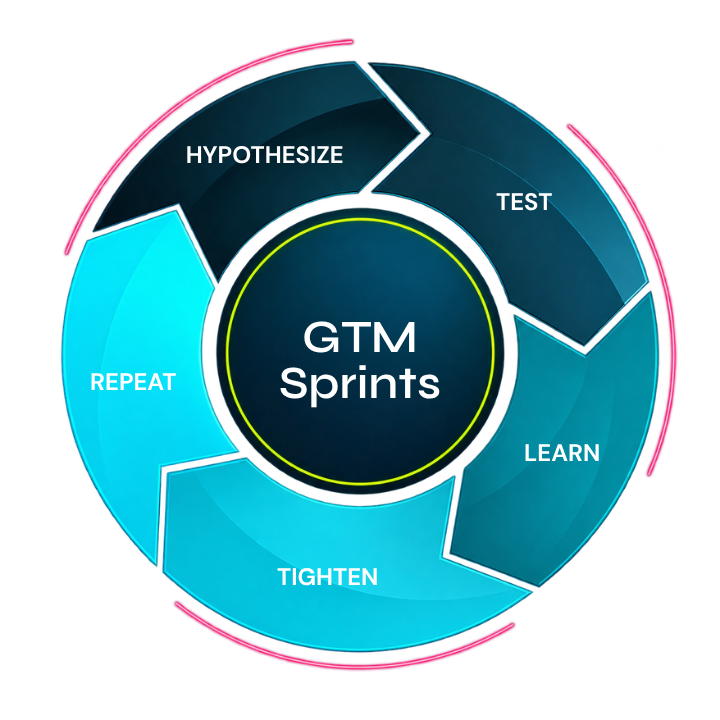
The operating rhythm behind everything below — time-boxed cycles where you hypothesize, test, learn, tighten, and repeat. Every strategy gets built and refined through this loop.
01
Strategic Foundation
Make product marketing your first problem to solve — before outbound, content, or paid ever enter the picture.
02
Funnel Repair
Fix your leaky bucket before you scale demand — optimizing retention, conversion, and consideration from the bottom up.
03
Channel Strategy
Find the channels that move the needle — then go all in, using the Bullseye Framework to test before you commit.
How GTM Sprints Work

Treat your GTM motion like a loop — not a launch.

In early-stage marketing, you can't spend months planning a "perfect" launch. You need signal, fast. That's why I'm a big believer in GTM sprints: time-boxed cycles where you place small bets, learn quickly, and turn what works into a repeatable play.

These sprints can be applied to anything from message testing to finding your channel mix.

How It Works

A sprint has five moves: align on a goal, form one clear hypothesis, run focused experiments, capture signal, then roll what you learned into the next cycle.

The point isn't the timeline — I've run sprints as short as two weeks and as long as six. It's the tempo: hypothesize → test → learn → tighten → repeat.

The market won't wait for your plan. If you're not learning quickly, you're just guessing very, very slowly — and burning budget while you do it.
AI Take: Build a Claude Project or a Custom GPT. Load the framework once, upload results each cycle, and pull clean signals every time.
GTM Sprint Loop
Tempo Matters. Timeline Doesn't.
GTM SPRINT 2–6 week cycles Hypothesize Test Learn Tighten Repeat
No. 1: Strategic Foundation
1

Make product marketing your first problem to solve.

At its core, product marketing is understanding your customer, clarifying the message, and mapping it to the moments that matter. It's the strategic work that should happen before execution — and usually doesn't.

When you skip it, you waste budget on activity that creates noise but doesn't convert. You end up with a great pitch deck, a polished website, and a sales team that still can't explain why someone should buy.

Prioritize it and everything else — outbound, content, partnerships, paid ads — gets more effective because it's been pressure-tested in real conversations with real buyers.

AI Take: Use Claude Opus to run workshops, deep dive into competitive analysis, and build a sales enablement hub. See these starter prompts.
Foundation-First Strategy
Start here. Iterate often.
Segmentation
The market, divided into meaningful groups to find where you can win.
ICP & Buyer Personas
Who you're for — and how they think, buy, and decide.
Positioning, Messaging & Value Prop
Where you stand, why buyers should care, and the words that make it land.
Competitive Intel
Know how buyers evaluate you versus alternatives — including doing nothing.
Pricing & Product Offering
What you sell, how you package it, and what it signals.
Sales Enablement
The tools your sales team needs to make your story repeatable.
Get these six right before you hire your first demand gen person. They give every channel a fighting chance to convert.
No. 2: Funnel Repair
2

Fix your leaky bucket before you scale demand.

When opportunities feel like they're disappearing or your churn rate is high, the instinct is to pour on more demand—more outbound, more content, more spend. But in early-stage, that's often the most expensive way to learn.

More leads won't save a broken message, a fuzzy ICP, or a demo that doesn't convert. If prospects are stalling, ghosting, or churning, the problem usually isn't volume — it's a leaky bucket.

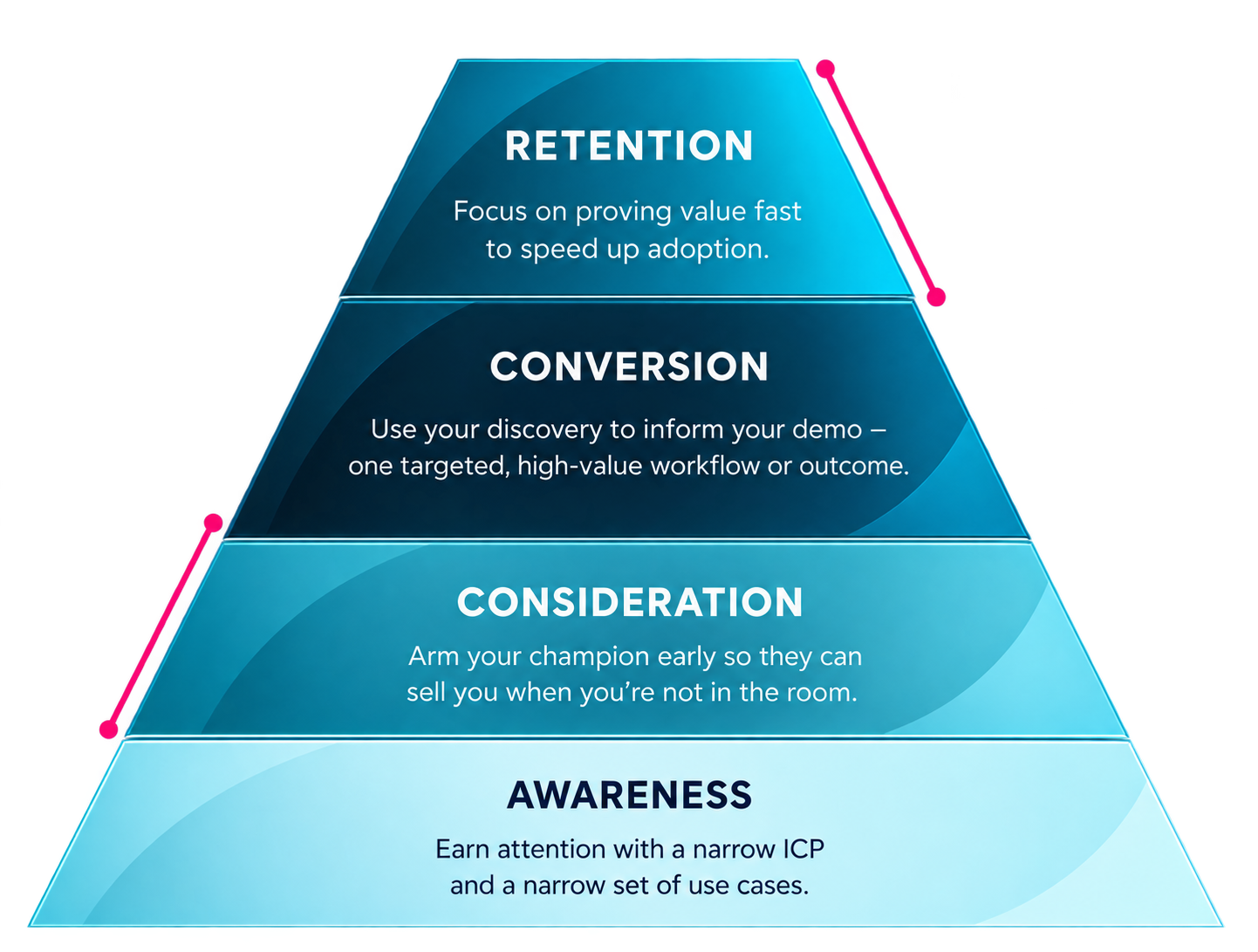
Start optimizing here: Earn awareness with a narrow ICP and a narrow set of use cases. Nurture consideration by arming your champion early. Convert by shortening your demo to one workflow. Retain your customers by proving value fast.
AI Take: Monitor drop-off by stage in Amplitude. Connect to the Claude API to synthesize signals and surface alerts in real time.
Upside-Down Funnel Repair
Optimize from the Bottom Up
RETENTION Focus on proving value fast to speed up adoption. CONVERSION Shorten your demo. One workflow. One outcome. Then stop talking. CONSIDERATION Arm your champion early so they can sell you when you're not in the room. AWARENESS Earn attention with a narrow ICP and a narrow set of use cases.
No. 3: Channel Strategy
3

Find the channels that move the needle — then go all in.

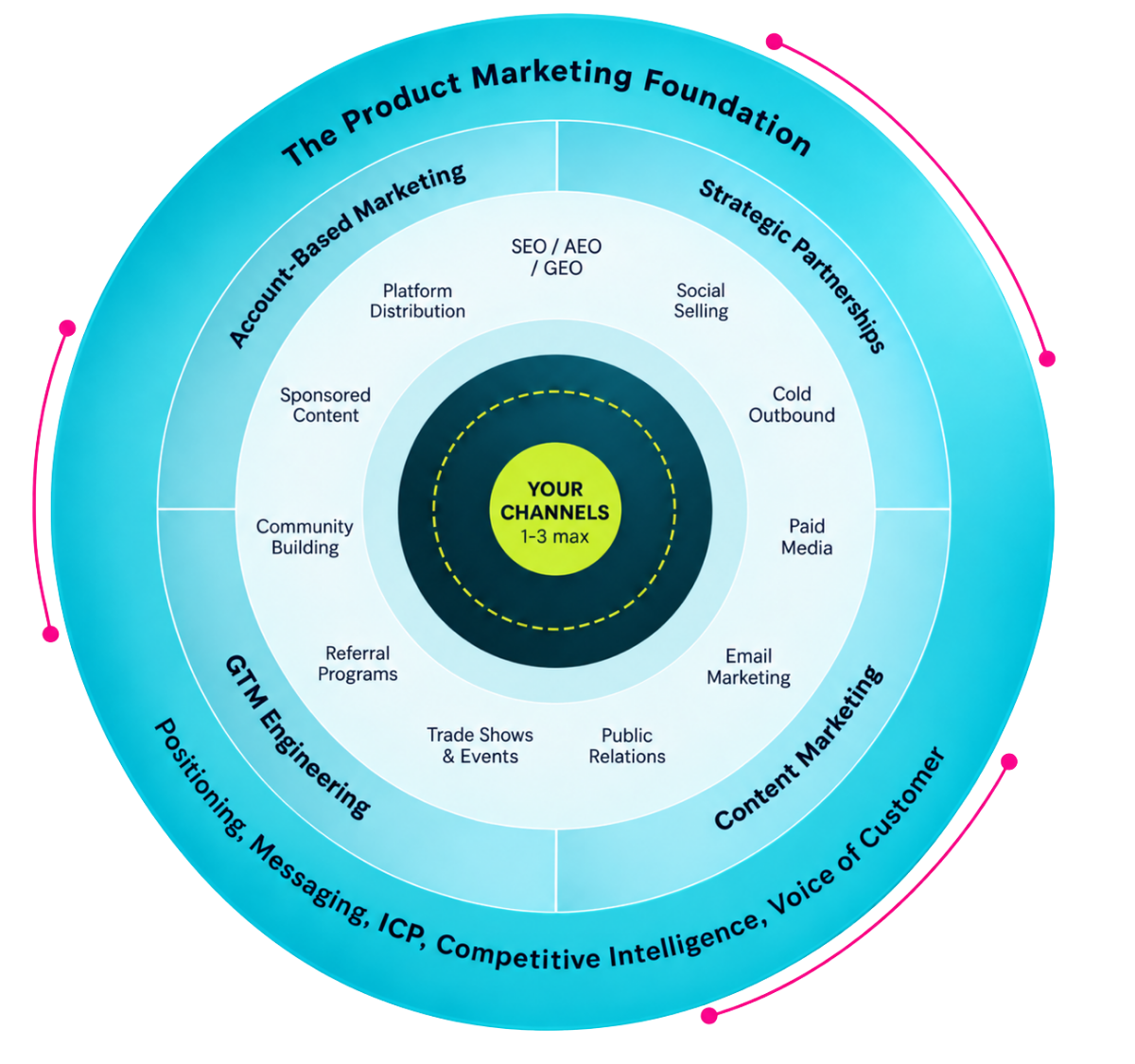
Most founders default to the channels they already know. The Bullseye Framework — from Traction by Gabriel Weinberg & Justin Mares — forces you to consider every traction channel before betting on any of them.

The process: brainstorm how you'd use every channel → rank them into inner circle, potential, and long shots → test your top 3–5 with small, cheap experiments → focus on what moves the needle.

And it will change. The channels that get you to $1M won't be the channels that get you to $10M. Your mix evolves as you scale — so keep running the process.
AI Take: Use Claude Code to build channel agents. Example: enrich leads by connecting to Apollo or Clay via API, auto-route by ICP fit, and trigger sequences in your CRM — without leaving your stack.
Bullseye Framework
Adapted for 2026
YOUR CHANNELS 1-3 max Strategic Partnerships Content Marketing GTM Engineering Account-Based Marketing SEO / AEO/ GEO SocialSelling ColdOutbound PaidMedia EmailMarketing PublicRelations Trade Shows& Events ReferralPrograms CommunityBuilding SponsoredContent PlatformDistribution

Jennifer Prishtina adapted this framework from Traction by Weinberg & Mares

Appendix

Appendix: Glossary

Strategic Foundation

Segmentation
Carving your market into meaningful groups to identify where you have the right to win.
ICP
The specific profile of your best-fit customer — who they are, what they need, and why they buy.
Buyer Personas
The specific people inside your ICP — their titles, motivations, objections, and how they buy.
Positioning & Value Prop
Where you sit in the market and the specific outcomes you deliver that make you worth buying.
Messaging
The language you use to communicate your positioning — pressure-tested in real sales conversations.
Competitive Intelligence
Actively monitoring alternatives — including doing nothing — so you know how buyers evaluate you.
Pricing Strategy
Pricing signals your positioning. The wrong model creates friction at the moment that matters most.
Sales Enablement
The battlecards, talk tracks, and objection-handling tools that make your sales story repeatable.

GTM Infrastructure

GTM Engineering
Using automation, AI, and custom tooling to build scalable, data-driven acquisition and conversion systems.
Content Marketing
Creating valuable content that attracts, educates, and converts — blogs, video, podcasts, webinars, and lead magnets.
Strategic Partnerships
Forming alliances with complementary companies to access their distribution, customer base, or credibility.
Account-Based Marketing
Orchestrating personalized campaigns targeting specific high-value accounts, aligning sales and marketing to convert.

Top Channels for 0→1

SEO / AEO / GEO
Optimizing so customers find you across search engines, AI answer engines, and generative platforms.
Social Selling
A founder or thought leader building their network and presence on platforms like LinkedIn to attract prospects through credibility, content, and direct engagement.
Cold Outbound
Proactively reaching out via email, phone, or DM to generate pipeline — especially high-value in early-stage B2B.
Email Marketing
Building and nurturing a direct line to prospects and customers through sequenced, targeted emails.
Trade Shows & Events
Getting in front of buyers and insiders at in-person gatherings — including hosted and sponsored events.

Additional Channels

Social Media
Building an organic brand presence across social platforms to grow awareness, trust, and inbound interest.
Public Relations
Getting coverage in media, podcasts, and industry publications to build awareness and credibility at scale.
Paid Media
Running paid ads across search, social, and display to reach and convert your target audience with measurable ROI.
Referral Programs
Turning customers, affiliates, and advocates into a structured acquisition channel through incentivized referrals.
Community Building
Creating and nurturing communities — forums, groups, Slack channels, user networks — around your product or problem space.
Sponsored Content
Partnering with newsletters, podcasts, and niche publications where your ideal customers already spend time.
Platform Distribution
Plugging into established marketplaces, app stores, AI ecosystems, and platform networks where your buyers already live.
Appendix: GTM Framework
GTM Framework for Startups
How the System Works Together
Three layers. One output. Each layer informs and amplifies the next.
Strategic Foundation
The thinking layer
Segmentation
Positioning
Value Proposition
Messaging
ICP
Buyer Personas
Competitive Intelligence
Pricing Strategy
Sales Enablement
informs
GTM Infrastructure
The operational layer
GTM Engineering
Content Marketing
Strategic Partnerships
Account-Based Marketing
amplifies
Traction Channels
The acquisition layer
SEO / AEO / GEO
Social Selling
Paid Media
Email Marketing
Social Media
PR
Cold Outbound
Trade Shows & Events
Referral Programs
Sponsored Content
Community Building
Platform Distribution
Pipeline & Revenue
Strategic Foundation
Start here. Return often. Everything downstream depends on it.
GTM Infrastructure
Often treated as channels. They're the engine underneath.
Traction Channels
Test before you commit. The right channel isn't always obvious.
Let's talk Early-Stage marketing

Open to New Marketing
Leadership Opportunities

Jennifer Prishtina · Startup's Guide to Marketing

Based in the live music capital of the world